Willow
Designing a fractional real estate investment exchange
Willow was a Canadian fintech startup building a platform that allowed investors to buy and trade fractional ownership in real estate, lowering the barrier to entry for a traditionally capital-intensive asset class. While fractional real estate platforms had begun emerging in the United States, the model had not yet been successfully introduced in Canada. Willow set out to make property investment accessible to everyday Canadians by combining the accessibility of fractional ownership with the liquidity of a trading exchange.
As the lead product designer, I partnered closely with product, engineering, and compliance teams to design both the consumer investment experience and the exchange interface from the ground up.
Role
Lead Product Designer
Focus
Interaction design, UI design, design system
Stage
0->1
Collaborators
Derek Vaz, Josiah Bilagot, With.co (Formerly DVXD)




Product Tension
Bridging two different investor mindsets
Real estate can be a strong long-term investment, but getting into the market usually requires significant capital and a willingness to hold for years.
Willow aimed to make real estate investing more accessible by allowing Canadians to buy fractional shares in properties. The challenge was designing for two very different ways of thinking about investing.
Property Investors
Focus on location and property quality
Think long term
Research before investing
Market Traders
Focus on price and market activity
Value liquidity
Make more frequent decisions
Lean too far toward trading and the experience becomes intimidating. Lean too far toward traditional real estate and it becomes difficult to support an active marketplace.
Finding the balance between the two became a central design challenge.
Key Experience Design
Real estate first, trading second
To bridge these two mental models, I pushed for a browse-first experience that felt more like a real estate platform than a trading app. More advanced trading tools could appear as investors became familiar with the product.
The experience was organized around three connected areas:
Browse — discover opportunities
Trade — buy and sell investments
Portfolio — track performance
This gave new investors a familiar place to start without limiting what more experienced investors could do.
Key Experience Design
Making real estate investing feel familiar
Early concepts used a map to make browsing properties feel similar to MLS or Airbnb. But with only about a dozen properties at launch, the map felt sparse and made comparison difficult.
I proposed a grid instead, making it easier to scan opportunities and compare properties side by side.
Each listing combined familiar property information with investment metrics like cap rate, net yield, dividends, 52-week highs and lows, and performance trends.
This gave investors a way to evaluate each opportunity as both a property and an investment.
Key Experience Design
Supporting a marketplace
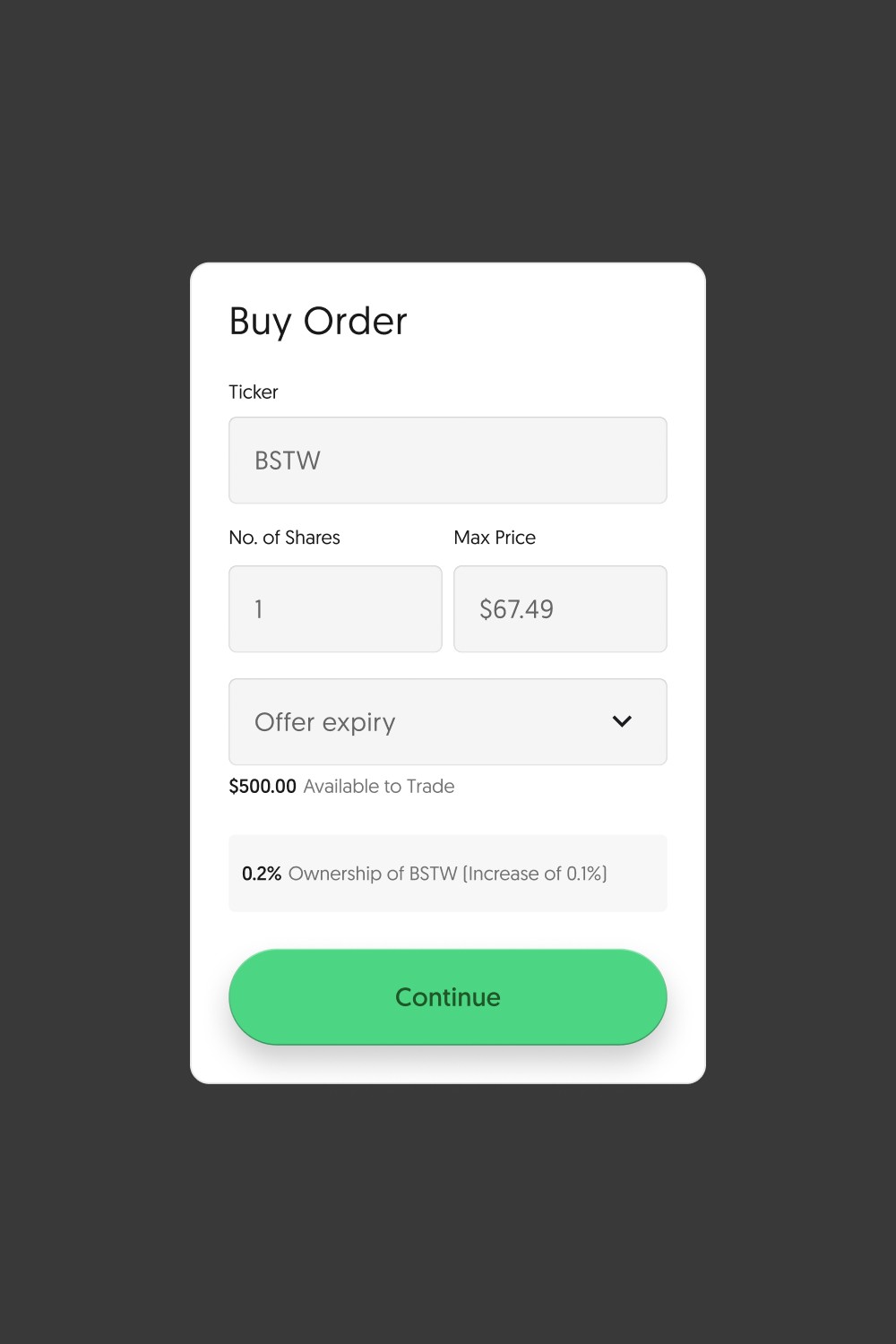
For investors who wanted to go deeper, Willow introduced a more traditional trading interface where they could analyze performance, compare properties, and place buy or sell orders.
The order flow had to support several scenarios, including pre-KYC reservations, primary investments, secondary market trades, and secure order confirmation.
I worked closely with engineering and compliance to make these workflows transparent enough to meet regulatory requirements without making them unnecessarily complex for new investors.
Key Experience Design
Connecting investments to real properties
The portfolio needed to show financial performance without losing the tangible connection to the properties themselves.
Holdings were shown geographically, helping investors see where their money was invested, alongside a more traditional portfolio view showing gain or loss, returns, ownership, and allocation.
Together, these views let investors understand their portfolio as both a collection of properties and a set of financial assets.
Designing for Constraints
A few constraints had a significant impact on the product.
Regulation
Willow was pursuing approval to operate as a regulated trading venue, so identity verification, disclosures, transaction transparency, and trade confirmations had to be built directly into the experience.
Limited inventory
With relatively few properties at launch, the experience needed to make a small marketplace still feel useful. This ultimately led us away from map-based browsing toward a comparison-focused grid.
User education
Fractional real estate investing was unfamiliar to many prospective investors. Onboarding and contextual guidance helped explain the model and Willow's concept of “propsharing," without requiring users to understand everything upfront.
Outcome
The work supported Willow's regulatory approval and resulted in a fully realized fractional real estate investment platform.
The product ultimately didn't gain enough traction to scale, but the underlying exchange technology was later acquired by another startup.
Reflection
This project reinforced how important it is to balance accessibility with transparency when designing financial products.
New investors needed enough familiarity and guidance to feel comfortable getting started, while more experienced investors needed the depth and control they expected from an investment platform.
Progressive disclosure helped bridge those needs without making the product feel either overly simplistic or unnecessarily complex.
© 2026 Nelson Leung in Canada.